Table Of Content

Three more locks, genetically identical with the other two, also had good (although not completely uninterrupted) provenance records. The seed of the project was sown then, but it took eight years and the input of several other specialists to develop it to the point of being published. All the complex multidisciplinary collaborations notwithstanding, the only person who has worked full-time on the project is Begg himself, now in his final PhD year at the University of Cambridge. While volunteering at the Ira F. Brilliant Center for Beethoven Studies at San José State University, Begg encountered the centre’s director at the time, historical musicologist William Meredith. Many astonishingly creative people have lived lives cut tragically short by illness.
Unlocking the code to Beethoven's life through his hair
But five of the locks, which came from various sources, clearly belong to a single individual with central European ancestry, which Beethoven would have had. The natural degradation of DNA over time in these locks was also consistent with the hair dating to the early 19th century. This elevated risk — paired with a potential liver infection and the composer’s alleged drinking habits — may have hastened Beethoven’s premature death at the age of 56, says Tristan Begg, a biological anthropologist at the University of Cambridge. In other words, a child born from an extramarital relationship in the composer’s family tree. These factors, along with his chronic drinking, were probably enough to cause the liver failure that is widely believed to have killed him, according to a study published Wednesday in the journal Current Biology.
‘Rivers in the sky’ have drenched California, yet even more extreme rains are possible
Begg and his colleagues scanned the composer’s genome for several conditions linked to hearing loss, including Paget’s disease and lupus. Beethoven had a number of genetic markers indicating a heightened risk of developing lupus, but because the condition is rare and doesn’t always lead to hearing loss, Begg doesn’t think it’s a strong contender as the cause of his deafness. Unfortunately, the cause of Beethoven’s hearing loss remains a mystery, but the analysis suggests that the composer probably died from liver disease brought on by a combination of factors. In addition, they found that all five hair samples were genetically identical. They had male XY karyotypes and shared mitochondrial genomes of haplogroup H1b1+16,362C with a rare private mutation. For Halm-Thayer and the Stumpff Locks, even documentary evidence supporting their authenticity was strong.
Best classical music
By the 1980s, despite a superficial uplift for the '84 Olympic games, Pershing Square was by all appearances a rundown cultural wasteland. In 1985 it was reported that no one, not even the Beethoven society led by the indomitable Joy Milane, came anymore to lay wreaths or sponsor ballets at Beethoven's feet to celebrate his birth and death. It appeared that the grand mission of those cultural elites of 1932, to make Los Angeles a city that even Chicago and Vienna would envy, had failed miserably. The Philharmonic left for the Music Center in 1960, leaving Beethoven behind to suffer the increasing weirdness of Pershing Square in brooding silence.
Scientists sequence Beethoven's genome using locks of his hair - Yahoo Movies Canada
Scientists sequence Beethoven's genome using locks of his hair.
Posted: Tue, 02 Apr 2024 00:05:15 GMT [source]
heart-melting quotations from composers’ love letters
Foerster's career seems to have tapered off after this, and when he passed away at 67 in 1943, his body was held at Pierce Brothers until his ex-wife Willa could be located. Knowing where his bread had been buttered, Foerster's final request was that his ashes be scattered in the shrubbery around the Beethoven statue. For every dignified occasion, like the planting of nine Eugina trees in a semi-colon behind the statue to symbolize Beethoven's ninth symphony, there was something just a little off. The work is “a great technological achievement,” says Walther Parson, a forensic molecular biologist at the Medical University of Innsbruck in Austria who has worked on other historic cases. These include the identification of two children of Nicholas II, the last Tsar of the Russian Empire, from remains discovered in 2007.
Society for Science
The team believes Beethoven's Hepatitis B infection could have been the driving force behind the composer's severe liver disease, which would then have been exacerbated by his alcohol intake and genetic risk. But certainty in both the timing of the infection and extent of alcohol consumption remains elusive. Although researchers didn’t find any clear genetic signs of what caused Beethoven’s gastrointestinal issues, they found that celiac disease and lactose intolerance were unlikely causes. In the future, the genome may offer more clues as we learn more about how genes influence health, Begg said. More importantly, several locks confirmed as far more likely to be from the composer's head demonstrate his death was probably the result of a hepatitis B infection, exacerbated by his drinking and numerous risk factors for liver disease. While researchers didn’t find any clear genetic signs of what caused Beethoven’s gastrointestinal issues, they found that celiac disease and lactose intolerance were unlikely causes.
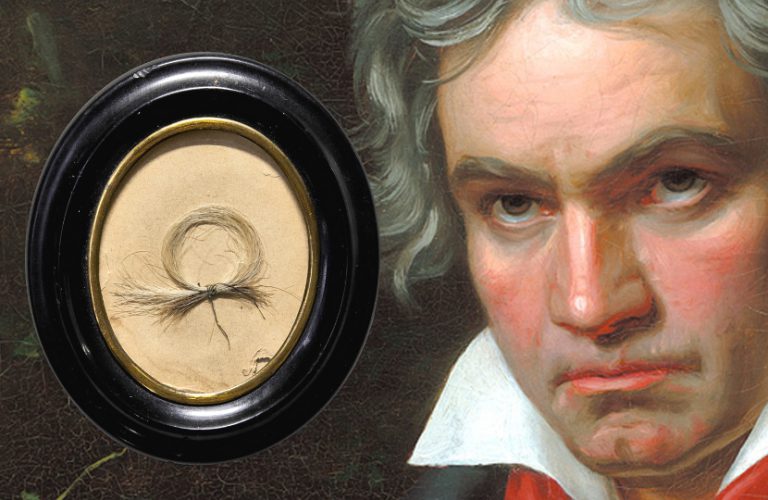
When a “substantial lock of the composer’s grey and dark brown hair” was announced for auction in Sotheby’s Important Manuscripts, Continental Books and Music sale, it was expected to fetch somewhere in the region of £12,000 to £15,000. Sotheby’s in London sold ‘a substantial lock of the composer’s grey and dark brown hair’ for more than double the expected amount. This study depicted how genomic data helped discover new information in the context of historical biography. The availability of more data in consumer genetic databases and testing of living and hypothesized relatives of Beethoven will help further dig into his genetic genealogy. Strikingly, sequencing analysis of Y chromosomes from five living members of the Van Beethoven patrilineage revealed an extra-pair paternity event in the musician's patrilineal ancestry. For much of his adult life, Beethoven was frequently tormented by pain and poor health – not to mention hearing loss.
DNA analysis of Beethoven’s hair reveals health issues — and a family secret - CNN
DNA analysis of Beethoven’s hair reveals health issues — and a family secret.
Posted: Wed, 22 Mar 2023 07:00:00 GMT [source]
This information will be used in future research studying musical genius. Another analysis indicated that Beethoven avoided opiate painkillers during his long and painful death, keeping his mind clear for his music, which he continued working on until the day he died. The key question of what caused Beethoven’s hearing loss is still unanswered, said Dr. Avraham Z. Cooper of Ohio State University, who was not involved in the study.
For example, a medical geneticist from the University of Bonn, where people are familiar with complex diseases. "Then we brought in genealogists from Belgium, who studied Beethoven's family tree to identify possible relatives." The idea for the research project came from Tristan Bregg, who had worked for the Beethoven Center in California. Three of the hair samples studied came from there, but only one of them was among the five that showed matches in DNA. The new analyses, which also looked for pathogens, were able to detect hepatitis B. Beethoven had repeatedly complained of back pains, and his DNA shows that he was susceptible to liver disease.
In 1971, a folk singer performed under the statue at lunchtime for a crowd that included "derelicts and pensioners, evangelists and hustlers, and a few neat and fresh office girls" -- a pretty good summation of the parks makeup, then and now. A large platform was set up on the Fifth Street side of the park around the veiled statue, trod upon by a group of illustrious citizens including Mayor John Porter, Arnold Foerster, and W.A. The invocation was performed by Bishop Bertrand Stevens, who stated that the statue was a reminder that "man does not live by bread alone." The Phil's conductor, Dr. Artur Rodzinsky, led the entire orchestra as it played Beethoven's Egmont overture. As the music ended, Mrs. Leafie Sloan-Orcutt, counselor of the Phil's women's committee, pulled a long white ribbon, revealing the statue to the public. In July, T.P. Hull, who called himself the California representative of the "Nation League," filed a protest against the erection of the proposed statue of Beethoven, or any other foreign person, in Pershing Square.
When their new findings through DNA analyses of Beethoven's hair were recently published, the media eagerly jumped on the story offering more insight into the life of the famous classical composer. Several of Beethoven’s friends kept locks of his hair, which was common practice at that time. The researchers extracted DNA from eight preserved locks thought to have come from the composer’s head. Other research projects had unsuccessfully tried to extract genetic material from Beethoven’s remains, but recent advances in sequencing DNA from very old samples made this new attempt possible, writes Nature News’ Dyani Lewis. The team sequenced two-thirds of Beethoven’s genome and examined it for clues on what might have led to his illnesses. They found that he was genetically predisposed to liver disease and had hepatitis B, at least in the months leading up to his death.
He gave anguished thought to these afflictions, especially his hearing loss, and hoped they would one day be understood and the explanation made public. Ludwig van Beethoven’s life was not quite as short; he was 56 when he died in 1827. Yet it was short enough to tantalise us as to what more he might have achieved, had he had better health. “We use this as an example to illustrate broader challenges of individual-level genetic predictions,” the authors wrote in the study. Usually, old bones serve as the basis for analysis, but that was not possible with Beethoven. "You could have exhumed Beethoven to perform such a genetic analysis with his bones," Krause says.
"Everything about this project has been fascinating," said Walsh, who worked with McCrone Research Institute, Chicago, and the APS on the analysis. "You can learn a great deal about a person from hair analysis and the labs at McCrone and Argonne used the most sophisticated technology available in the world today for this project." Since he died in 1827 at age 57, there has been much speculation but no proof as to the cause of Beethoven's illnesses and death. Comparing the DNA of the "Beethovens" living in Belgium today, they found that they were related to each other, but there was no DNA from the composer. "We were surprised by this family secret, which shows that Beethoven was not genetically descended from the Flemish Beethoven line, but we don't know which generation is responsible," Begg explains in a separate YouTube video.
The team ended up ruling out three locks of hair previously ascribed to Beethoven as not his, including the "Hiller lock," which was found to be from a woman. That lock was linked to lead poisoning, which can now no longer be attributed to Beethoven's health demise. Similarly, the team couldn’t find a genetic explanation for Beethoven's gastrointestinal issues, but did note that his genetics showed that both coeliac disease and lactose intolerance were highly unlikely. He also had a "certain degree of genetic protection against risk of irritable bowel syndrome," which has often been blamed for his complaints. Now, scientists have taken the closest look yet at the composer’s health by analyzing DNA extracted from preserved locks of his hair, according to a new study published Wednesday in the journal Current Biology.
Future study of Beethoven’s DNA may also answer historical questions about Beethoven’s ethnicity; as a young man, Beethoven was sometimes called “the Moor” because of his dark skin, and some historians wonder if he had some African blood. His hair didn’t show any of the wrinkles or bends typical of people of African descent, but the jury’s still out on that question. One ailment of Beethoven’s that probably can’t be pinned on lead poisoning is his deafness. However, DNA analysis of the hair has already defined a significant portion of Beethoven’s genetic make-up, and as our understanding of the human genetic code grows, we may be able to find clues to his deafness within his DNA.
Nathaniel was a musical prodigy from Ohio who had studied at Julliard before his crippling schizophrenia took hold. He ended up homeless in Los Angeles in 2000, where he spent his days playing music, until a friendship with reporter Steve Lopez enhanced and improved both their lives. Nathaniel worships the Beethoven statue, speaking about it constantly and looking to it as something more than a sculpture, as some kind of god that moves him and keeps him going. Lopez wrote a series of articles about Nathaniel that inspired thousands of people. This denial was comical when one acknowledges that by the time of Foerster's death, the Beethoven statue had primarily become one big poop joke. By 1941, the trees that had been symbolically planted around Beethoven had become a haven for pigeons, who had turned his flowing hair, as well as frock coat, white.




No comments:
Post a Comment